The Hispanic-Anglosphere …
A research network of scholars and non-academic partners from all around the world who are tracing curious and long-enduring entanglements of the global Hispanic and Anglo worlds, particularly in relation to the British Isles (Cornwall, England, Ireland, Scotland, Wales, the Channel Islands and the Isle of Man)
‘Transition’ – listen here to the podcast
Just click below if you missed or want to listen again the public conversation we held last Saturday on ‘Transition: tips and ideas from the Hispanic-Anglosphere (late 18th – early 20th centuries’ at the Wessex Center, a contemporary venue nestled in the beautiful inner close of the Winchester Cathedral. The event was organized by the Modern History Research Centre of the University of Winchester and our international research network The Hispanic-Anglosphere: transnational networks, global communities, a project funded by the Arts and Humanities Council and the University of Winchester in association with the National Trust.
We are aiming to provide soon full video as well, so keep tuned – and Enjoy!
Notes on key speakers:
Natalia Sobrevilla Perea is Professor of Latin American History and head of Hispanic studies at the University of Kent. She is also the principal investigator of the research network ‘War and Nation: identity and the process of state-building in South America (1800-1840)’. Dr Sobrevilla Perea was awarded her doctorate by the University of London in 2005 and her undergraduate degree was from the Pontificia Universidad Católica del Perú (1996). Her research interests include state formation and political culture in the Andes from the end of the colonial period throughout the nineteenth century as well as issues of identity, race and ethnicity, and military culture in the nineteenth and twentieth centuries in South America.
Eduardo Posada-Carbó is Professor of the History and Politics of Latin America at the School of Interdisciplinary Area Studies and William Golding Senior Fellow at Brasenose College University of Oxford. He has been a visiting professor at various universities in Europe and in the Americas and has published extensively on the history and politics of Latin America, with a focus on Colombia. He is the author of La nación soñada. Violencia, liberalismo y democracia en Colombia (2006), and of articles published in the Historical Journal, Hispanic American Historical Review, Latin American Research Review, Intellectual History Review, Journal of Democracy, Journal of Latin American Studies, and Revista de Indias. He has also edited Elections Before Democracy. The History of Elections in Europe and Latin America (1996); (with Iván Jaksic), Liberalismo y poder. Latinoamérica en el siglo XIX (2011); and more recently a five volume history of Colombia, published by the Fundación Mapfre and Penguin Random House in Madrid.
Helen Cowie is Senior Lecturer in the Department of History at the University of York and a member of its Centre for Eighteenth Century Studies. Her research focuses on the cultural history of science with a particular focus on the history of animals. She has published extensively on the subject, including Cowie, H.L. (2017) ‘From the Andes to the Outback: Acclimatising Alpacas in the British Empire‘ Journal of Imperial and Commonwealth History, vol 45, no. 4, pp. 551-579 and her book Cowie, H.L. (2014) Exhibiting Animals in Nineteenth-Century Britain: Empathy, Education, Entertainment. Palgrave Macmillan, Basingstoke.
Andrés Baeza Ruz is Postdoctoral Research Fellow on transnational education (Instituto de Historia de la Pontificia Universidad Católica de Chile) has a PhD in Latin American History from the University of Bristol and is currently leading a programme of reform of the educational syllabus in Chile. His book Contacts, Collisions and Relationships: Britons and Chileans in the Independence Era, 1806-1831 has been recently published by Liverpool University Press (31st March 2019).
Graciela Iglesias-Rogers is Senior Lecturer in Modern European and Global Hispanic History at the University of Winchester and Principal Investigator in the AHRC-University of Winchester research network ‘The Hispanic-Anglosphere: transnational networks, global communities (late 18th-ealy 20th centuries) in partnership with the National Trust. She is also a former Reuters Fellow with a long career in journalism. An Oxford graduate (St. Hilda’s) and postgraduate (LMH) both as a mature student, her first academic book, British Liberators in the Age of Napoleon: volunteering under the Spanish Flag in the Peninsular War (London and New York: Bloomsbury, 2014) has been followed by other works, including a book co-edited with Prof. David Hook, Translations in Times of Disruption: an interdisciplinary study in transnational contexts (Basingstoke: Palgrave Macmillan, 2017).
How to find us tomorrow 3 pm at the Winchester Cathedral’s Wessex Center
Come and join us in this open and free public conversation at the Winchester Cathedral’s Wessex Centre, access is via Dome Alley walking from the Cathedral’s inner courtyard – click HERE for a detailed map.
Saturday 11 May 2019, 3-5 pm
TRANSITION

A few tips and ideas from the Hispanic–Anglosphere
(late 18th-early 20th centuries)

Everyday the news has been jam-packed with stories about impending transformation – call it Brexit, the twilight of the modern Elizabethan era with the possibility of a male regency, the end of the fossil economy and the rapid growth of the so-called industries of the future (virtual reality, driverless cars, etc.). Change brings both challenges and opportunities. The history of the British Isles and the global Hispanic world is full of good and bad examples of how to get through periods of transition. Five leading scholars from around the world have been invited to share through a round-table discussion a few tips and ideas about various experiences, particularly from the late eighteenth to early twentieth centuries, a period marked by the dislocation of global polities, the rise and fall of monarchies, empires and republics, nation-state building, the rise of nationalism as well as by technological and biological innovations that altered landscape and infrastructures forever.
Speakers: Dr Andrés Baeza Ruz (Pontificia Universidad Católica de Chile), Dr Helen Cowie (University of York), Prof. Eduardo Posada-Carbó (University of Oxford), Prof. Natalia Sobrevilla Perea (University of Kent); chaired by Dr Graciela Iglesias-Rogers (University of Winchester).
The event is organized by the Modern History Research Centre of the University of Winchester in association with The Hispanic-Anglosphere: transnational networks, global communities (late 18th-20th centuries)’, an international research network funded by the AHRC and the University of Winchester in partnership with the National Trust. For more info, please contact Dr Graciela Iglesias-Rogers (G.IglesiasRogers@winchester.ac.uk ) and/or visit the project’s online platform http://hispanic-anglosphere.com .
All welcome!
Notes on Speakers:
Natalia Sobrevilla Perea is Professor of Latin American History and head of Hispanic studies at the University of Kent. She is also the principal investigator of the research network ‘War and Nation: identity and the process of state-building in South America (1800-1840)’. Dr Sobrevilla Perea was awarded her doctorate by the University of London in 2005 and her undergraduate degree was from the Pontificia Universidad Católica del Perú (1996). Her research interests include state formation and political culture in the Andes from the end of the colonial period throughout the nineteenth century as well as issues of identity, race and ethnicity, and military culture in the nineteenth and twentieth centuries in South America.
Eduardo Posada-Carbó is Professor of the History and Politics of Latin America at the School of Interdisciplinary Area Studies and William Golding Senior Fellow at Brasenose College University of Oxford. He has been a visiting professor at various universities in Europe and in the Americas and has published extensively on the history and politics of Latin America, with a focus on Colombia. He is the author of La nación soñada. Violencia, liberalismo y democracia en Colombia (2006), and of articles published in the Historical Journal, Hispanic American Historical Review, Latin American Research Review, Intellectual History Review, Journal of Democracy, Journal of Latin American Studies, and Revista de Indias. He has also edited Elections Before Democracy. The History of Elections in Europe and Latin America (1996); (with Iván Jaksic), Liberalismo y poder. Latinoamérica en el siglo XIX (2011); and more recently a five volume history of Colombia, published by the Fundación Mapfre and Penguin Random House in Madrid.
Helen Cowie is Senior Lecturer in the Department of History at the University of York and a member of its Centre for Eighteenth Century Studies. Her research focuses on the cultural history of science with a particular focus on the history of animals. She has published extensively on the subject, including Cowie, H.L. (2017) ‘From the Andes to the Outback: Acclimatising Alpacas in the British Empire‘ Journal of Imperial and Commonwealth History, vol 45, no. 4, pp. 551-579 and her book Cowie, H.L. (2014) Exhibiting Animals in Nineteenth-Century Britain: Empathy, Education, Entertainment. Palgrave Macmillan, Basingstoke.
Andrés Baeza Ruz is Postdoctoral Research Fellow on transnational education (Instituto de Historia de la Pontificia Universidad Católica de Chile) has a PhD in Latin American History from the University of Bristol and is currently leading a programme of reform of the educational syllabus in Chile. His book Contacts, Collisions and Relationships: Britons and Chileans in the Independence Era, 1806-1831 has been recently published by Liverpool University Press (31st March 2019).
Graciela Iglesias-Rogers is Senior Lecturer in Modern European and Global Hispanic History at the University of Winchester and Principal Investigator in the AHRC-University of Winchester research network ‘The Hispanic-Anglosphere: transnational networks, global communities (late 18th-ealy 20th centuries) in partnership with the National Trust. She is also a former Reuters Fellow with a long career in journalism. An Oxford graduate (St. Hilda’s) and postgraduate (LMH) both as a mature student, her first academic book, British Liberators in the Age of Napoleon: volunteering under the Spanish Flag in the Peninsular War (London and New York: Bloomsbury, 2014) has been followed by other works, including a book co-edited with Prof. David Hook, Translations in Times of Disruption: an interdisciplinary study in transnational contexts (Basingstoke: Palgrave Macmillan, 2017).

Welcome to Charles Ball – your host for this Saturday’s event
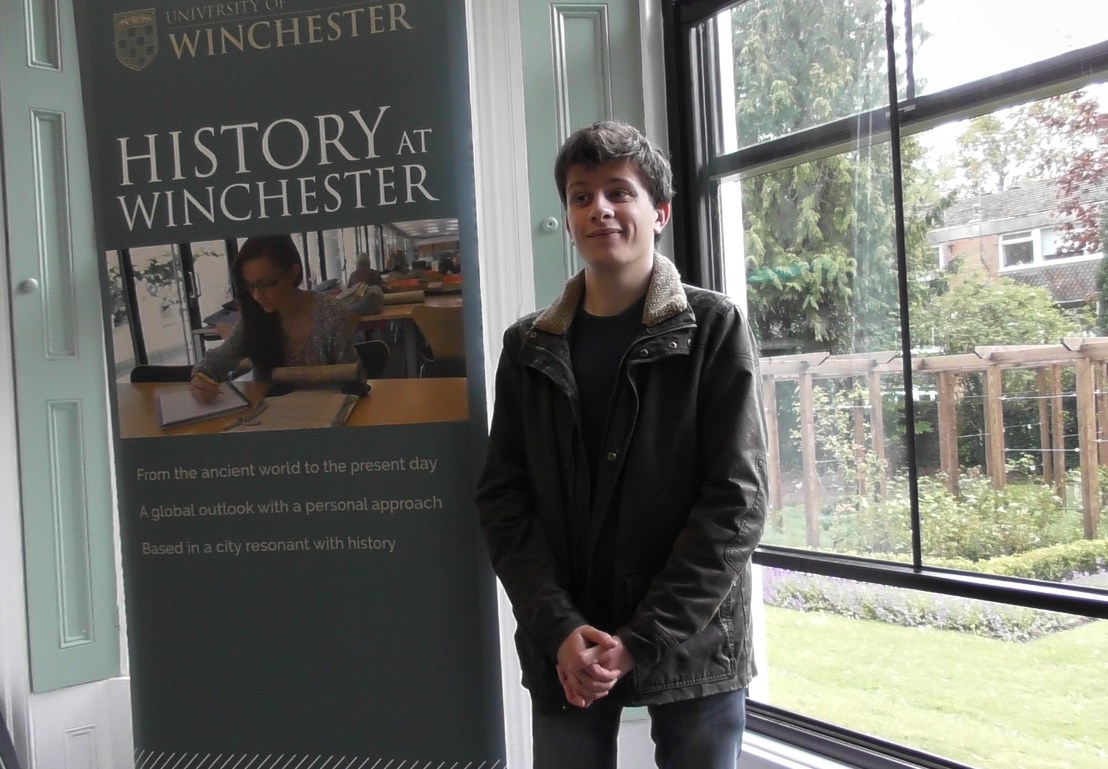
Say hello to our publicity officer for this Saturday’s public event at the Winchester Cathedral’s Wessex Center on ‘Transition: tips and ideas from the Hispanic-Anglosphere’ (3-5 pm).
Charles was selected among dozens of candidates to the Winchester Research Apprenticeship Programme (WRAP). This is a scheme for University of Winchester undergraduate students that provides opportunities to work on ‘live’ research projects alongside academics.
He has joined our ranks to assist in the organization of our upcoming event of the Modern History Research Center in association with the Hispanic-Anglosphere project. More info about the event here: https://hispanic-anglosphere.com/2019/04/04/transition-a-few-tips-and-ideas-saturday-11th-may-3pm-winchester-cathedrals-wessex-center/
Look for him if you need any guidance on how to get to the room or any other query on the day. He will also be preparing a report – so do not worry if you see him around taking notes, photos and videos…
See you all on Saturday!
Transition: a few tips and ideas… Saturday 11th May, 3pm, Winchester Cathedral’s Wessex Center
Come and join us in this open and free event:
A public conversation at the Winchester Cathedral’s Wessex Centre,
Saturday 11 May 2019, 3-5 pm
TRANSITION
A few tips and ideas from the Hispanic–Anglosphere
(late 18th-early 20th centuries)
Everyday the news has been jam-packed with stories about impending transformation – call it Brexit, the twilight of the modern Elizabethan era with the possibility of a male regency, the end of the fossil economy and the rapid growth of the so-called industries of the future (virtual reality, driverless cars, etc.). Change brings both challenges and opportunities. The history of the British Isles and the global Hispanic world is full of good and bad examples of how to get through periods of transition. Five leading scholars from around the world have been invited to share through a round-table discussion a few tips and ideas about various experiences, particularly from the late eighteenth to early twentieth centuries, a period marked by the dislocation of global polities, the rise and fall of monarchies, empires and republics, nation-state building, the rise of nationalism as well as by technological and biological innovations that altered landscape and infrastructures forever.
Speakers: Dr Andrés Baeza Ruz (Pontificia Universidad Católica de Chile), Dr Helen Cowie (University of York), Prof. Eduardo Posada-Carbó (University of Oxford), Prof. Natalia Sobrevilla Perea (University of Kent); chaired by Dr Graciela Iglesias-Rogers (University of Winchester).
The event is organized by the Modern History Research Centre of the University of Winchester in association with The Hispanic-Anglosphere: transnational networks, global communities (late 18th-20th centuries)’, an international research network funded by the AHRC and the University of Winchester in partnership with the National Trust. For more info, please contact Dr Graciela Iglesias-Rogers (G.IglesiasRogers@winchester.ac.uk ) and/or visit the project’s online platform http://hispanic-anglosphere.com .
All welcome!
Notes on Speakers:
Natalia Sobrevilla Perea is Professor of Latin American History and head of Hispanic studies at the University of Kent. She is also the principal investigator of the research network ‘War and Nation: identity and the process of state-building in South America (1800-1840)’. Dr Sobrevilla Perea was awarded her doctorate by the University of London in 2005 and her undergraduate degree was from the Pontificia Universidad Católica del Perú (1996). Her research interests include state formation and political culture in the Andes from the end of the colonial period throughout the nineteenth century as well as issues of identity, race and ethnicity, and military culture in the nineteenth and twentieth centuries in South America.
Eduardo Posada-Carbó is Professor of the History and Politics of Latin America at the School of Interdisciplinary Area Studies and William Golding Senior Fellow at Brasenose College University of Oxford. He has been a visiting professor at various universities in Europe and in the Americas and has published extensively on the history and politics of Latin America, with a focus on Colombia. He is the author of La nación soñada. Violencia, liberalismo y democracia en Colombia (2006), and of articles published in the Historical Journal, Hispanic American Historical Review, Latin American Research Review, Intellectual History Review, Journal of Democracy, Journal of Latin American Studies, and Revista de Indias. He has also edited Elections Before Democracy. The History of Elections in Europe and Latin America (1996); (with Iván Jaksic), Liberalismo y poder. Latinoamérica en el siglo XIX (2011); and more recently a five volume history of Colombia, published by the Fundación Mapfre and Penguin Random House in Madrid.
Helen Cowie is Senior Lecturer in the Department of History at the University of York and a member of its Centre for Eighteenth Century Studies. Her research focuses on the cultural history of science with a particular focus on the history of animals. She has published extensively on the subject, including Cowie, H.L. (2017) ‘From the Andes to the Outback: Acclimatising Alpacas in the British Empire‘ Journal of Imperial and Commonwealth History, vol 45, no. 4, pp. 551-579 and her book Cowie, H.L. (2014) Exhibiting Animals in Nineteenth-Century Britain: Empathy, Education, Entertainment. Palgrave Macmillan, Basingstoke.
Andrés Baeza Ruz is Postdoctoral Research Fellow on transnational education (Instituto de Historia de la Pontificia Universidad Católica de Chile) has a PhD in Latin American History from the University of Bristol and is currently leading a programme of reform of the educational syllabus in Chile. His book Contacts, Collisions and Relationships: Britons and Chileans in the Independence Era, 1806-1831 has been recently published by Liverpool University Press (31st March 2019).
Graciela Iglesias-Rogers is Senior Lecturer in Modern European and Global Hispanic History at the University of Winchester and Principal Investigator in the AHRC-University of Winchester research network ‘The Hispanic-Anglosphere: transnational networks, global communities (late 18th-ealy 20th centuries) in partnership with the National Trust. She is also a former Reuters Fellow with a long career in journalism. An Oxford graduate (St. Hilda’s) and postgraduate (LMH) both as a mature student, her first academic book, British Liberators in the Age of Napoleon: volunteering under the Spanish Flag in the Peninsular War (London and New York: Bloomsbury, 2014) has been followed by other works, including a book co-edited with Prof. David Hook, Translations in Times of Disruption: an interdisciplinary study in transnational contexts (Basingstoke: Palgrave Macmillan, 2017).
Key location under threat in Callao (Peru)
A new panel in our online exhibition calls attention to the sad fate of the home and office of the ‘honest’, yet ‘ostentatious’ Irish merchant Thomas Conroy (c.1806–1885). Still standing in the heart of Callao (Lima, Peru), this key location of the Hispanic-Anglosphere is currently under threat. The building is suffering under the elements and has been covered in graffiti regardless of having been declared a monument in 1972.

View of Thomas Conroy’s residence in Callao, as it stood in 2012. Photograph kindly provided by Juan Manuel Dávila Herrera, founder of the blog “Callao Centro Histórico” [http://www.callaocentrohistorico.com/2012/06/]
You can also find in the Individuals section of our website a profile of its founder, a merchant known throughout his 65 years of residence in Peru for his ‘hard work, honesty and love towards his fellow men’!
‘Quinta Waddington’ in Exploring the Hispanic-Anglosphere
A panel dedicated to the ‘Quinta Waddington‘ in our current online exhibition inaugurates a new series of entries aimed at highlighting ‘Key Locations’ in the Hispanic-Anglosphere during the late eighteenth to the early twentieth centuries.
Located in Valparaiso, Chile, this country residence was named in honour of Joshua Waddington (1792 – 1876), a native of Headingley, Yorkshire (England) who made fortune after arriving in Chile in 1817 and did much to promote Protestantism in that part of the world, albeit being himself a Catholic.
Learn more about him, his work and the ‘quinta’ by visiting our website!
Start the New Year with the online exhibition “Exploring the Hispanic-Anglosphere”
It’s time to relax and discover through text, images and sound a small sample of the contribution made by people in the British Isles closely engaged with the global Hispanic world, regardless of their birth, religion or political allegiance, as well as by those people who came from the Hispanic world to the British Isles as visitors, exiles and/or migrants.
The exhibition “Exploring the Hispanic-Anglosphere” is the outcome of the first phase of research of the AHRC-funded project ‘The Hispanic-Anglosphere: transnational networks, global communities (late 18-early 20th century) in partnership with the National Trust under the curatorship of the project’s Principal Investigator Dr Graciela Iglesias-Rogers.
The information throughout this exhibition has been peer-reviewed and it is based on disclosed and verifiable sources; it is being published under open-access criteria with guidelines for citation. Just click HERE or on any of these panels below to start exploring the Hispanic-Anglosphere…
Hope from the roots up to the rafters
The Bollaert slab: a fertile discovery
The port of Iquique, c. 1880-1890s
Oddity and sacrifice after exile in Jersey
A sound friendship forged in war
Master Lacy, the famous ‘young’ Spaniard
The risky appeal of the common people
A translation that improved the original
More panels will be added in the following months. In the meantime, try also exploring the archival and bibliographical Resources we are also offering in this site, including a Hispanic Itinerary of the National Trust Tyntesfield. Enjoy – and Happy New Year!
Great first airing at the IHR!
Positive, insightful and very helpful comments were gathered during the first airing at the Institute of Historical Research in London of one of the working papers already emanating from our project: “Spanish ‘colonies’: a term forged in the Hispanic-Anglosphere” by Dr Graciela Iglesias-Rogers (University of Winchester) and Dr José Brownrigg-Gleeson Martínez (University of Salamanca). It was almost full house at the meeting organized by the Latin American History Seminar of the IHR and chaired by Dr Alejandra Irigoin (LSE-Department of Economic History). Discussions were enriched by interventions from both early career and veteran scholars from a variety of disciplines, including Prof Mark Thurner (SOAS-Latin American Studies) who is currently editing a multi-authored book on the subject of colonialism and global decolonization and our own colleague Dr Karen Racine (University of Guelph, Canada) who also kindly took the photos you can see here. Indeed, if you happen to be at Oxford this afternoon, do not miss her talk at 5 pm entitled ‘Mock Monarchy: Latin American Royal Exiles in London and their Effect on British Constitutional Debates’ at the Main Seminar Room, the Latin American Centre, 1 Church Walk, Oxford.
And for learning more or just to catch up with the latest regarding our project, come next Wednesday 24th October (11:10-13:00) to the talk by our Principal Investigator ‘Entangled History: the Hispanic-Anglosphere Project (Concepts, Methods and Public Engagement)’ organized by The Global History of Europe in the Long Nineteenth Century Seminar, at the McGregor Room, Oriel College, University of Oxford, Oxford OX1 4EW, UK. All welcome, but if you are not a member of the university, just drop an email before attending to Prof. James McDougall (james.mcdougall@trinity.ox.ac.uk).
Spreading the word – Events
With ‘Scroll-Free September’ over, we are back spreading the word! Here are details of a few talks and events that could be of interest to you in the coming weeks:
- Tuesday 16th October (17:30-19:30)
(Institute of Historical Research, Latin American History seminar / Venue: Peter Marshall Room N204, 2nd floor, IHR, North block, Senate House, Malet Street, London WC1E 7HU, UK)
Spanish colonies’: a term forged in the Hispanic-Anglosphere
Graciela Iglesias-Rogers (University of Winchester) and José Brownrigg-Gleeson Martínez (University of Notre Dame)
The legal codes of the Spanish Monarchy never employed the term ‘colonias’ (colonies) to refer to its overseas dominions. The absence from the Spanish juridical lexicon had political implications highlighted by the decree of 22 January 1809 that famously stated that the American dominions ‘are neither colonias nor feitorias, but an essential and integral part of the Spanish Monarchy’. This paper, arising from the AHRC-University of Winchester project in partnership with the National Trust ‘The Hispanic-Anglosphere: transnational networks, global communities (late 18th to early 20th centuries), traces the way and the extent to which the word ‘colonies’ managed to root itself into a Spanish context through a negative shift in meaning within the Anglo world largely driven by Irish revolutionaries.
For more information, contact: Dr Paulo Drinot (paulo.drinot@ucl.ac.uk)
- Wednesday 24th October (11:10-13:00)
(The Global History of Europe in the Long Nineteenth Century Seminar/ Venue: McGregor Room, Oriel College, University of Oxford, Oxford OX1 4EW, UK)
Entangled History: the Hispanic-Anglosphere Project (Concepts, Methods and Public Engagement)
Graciela Iglesias-Rogers (University of Winchester)
A chance to learn about the rationale behind, the experience and latest developments in our project funded by the AHRC and the University of Winchester in partnership with the National Trust.
For more information, contact: Prof. James McDougall (james.mcdougall@trinity.ox.ac.uk)
- Wednesday 24th to Friday 26th October
(Instituto Español de Estudios Estratégicos (IEEE), CESEDEN, Ministry of Defense, Madrid, Spain)
Liderazgo Estratégico: de la Historia a los retos del Futuro / Strategic Leadership: Past, Present And Future
This is an international conference coordinated by our colleague Dr. Agustín Guimerá Ravina. It will be attended by 18 experts in history, defence and security, social psychology and the world of business from Spain, the UK and France. The aim is to explore the evolution of strategic leadership in Europe since early modern times, with a long-term, international and multidisciplinary approach. The programme includes a number of papers of interest to the Hispanic-Anglosphere project (ex. Prof. Andrew Lambert, King’s College London, “Enseñanza a través del ejemplo: ‘La campaña de Trafalgar’, de Julian Corbett, 1910/ Teaching by example: Julian Corbett’s “The Campaign of Trafalgar” of 1910).
For more information, including a full programme: contact Dr. Agustín Guimerá Ravina, (agustin.guimera@cchs.csic.es)
Records of 3,000 volunteers in Latin America now in our site!
The database compiled by Prof. Matthew Brown of English, Irish, Scottish, Welsh and other European Adventurers in Gran Colombia (modern day Ecuador, Colombia, Panama and Venezuela) during and after the Latin American Wars of Independence (c.1810-c.1830) is now available in the Resources area of our site.
This electronic resource features the names of over three thousand men and women. The first arrived in Venezuela in 1811; the last died in Ecuador in 1890. Over half were Irish. Several thousand died quickly upon arrival, or returned home just as soon; several hundred stayed and settled in Gran Colombia.
It is a closed and abbreviated database produced between 2000 and 2006 drawing on sources cited in the bibliography of Prof. Matthew Brown’s book Adventuring through Spanish colonies: Simón Bolívar, Foreign Mercenaries and the Birth of New Nations, Liverpool University Press, 2006; translated into Spanish by Katia Urteaga Villanueva and published by La Carreta Editores as Aventureros, mercenarios y legionarios extranjeros en la independencia de Colombia, 2010.
Many individuals whose presence in Gran Colombia is not widely known are listed, alongside more celebrated/notorious individuals including: Gregor MacGregor, a Scotsman who in 1819 declared himself ‘Inca of New Granada’; Daniel O’Leary, an Irishman who served as Simón Bolívar’s assistant for many years and later became British ambassador in Colombia and an important historian; James Rooke, who died of the wounds he received in the battle of Pantano de Vargas (1819), and whose last words were ‘Long Live the Land Which Will Bury Me!’.
Prof. Matthew Brown is happy to provide more information he has relating to individuals featured in his database – please just send him an email (matthew.brown@bristol.ac.uk) or contact him on social media @mateobrown. You may already find further information emanating from the work undertaken by other members of our network by simply using the ‘Search’ facility in this site (see above, right hand side of the screen).
Enjoy – and good luck with your research!
Successful launch of an ambitious pilot experience
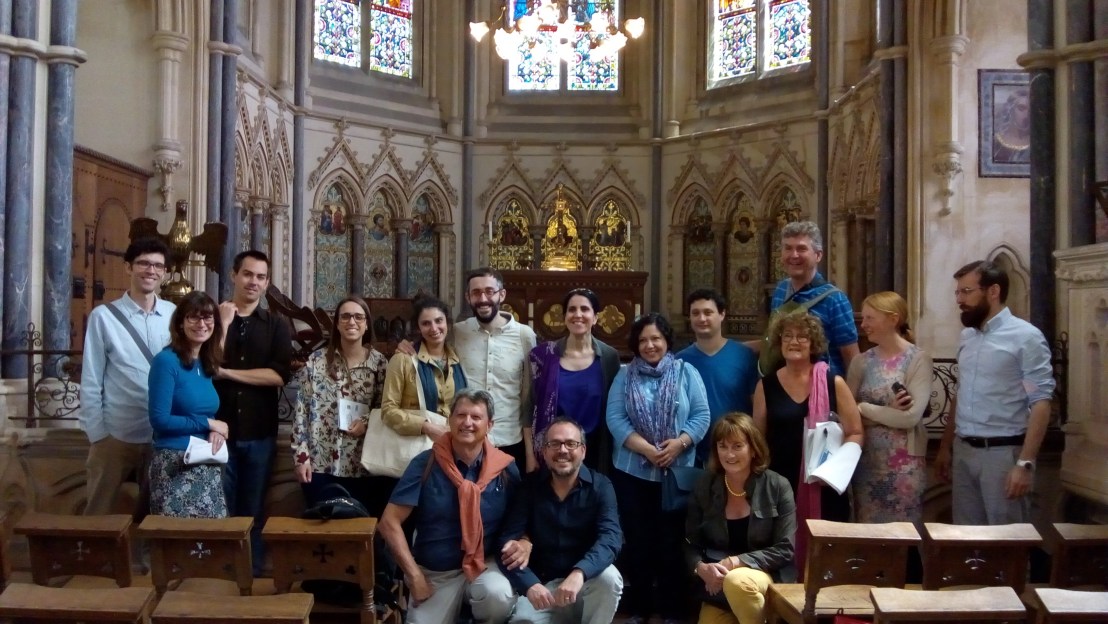
A few members of the Hispanic-Anglosphere network in the chapel of NT Tyntesfield.
Twenty-two scholars and non-academics from around the world participated in the successful launch of our online exhibition Exploring the Hispanic-Anglosphere, part of a series of events that took place at the National Trust Tyntesfield last Saturday (23rd June) to continue our conversation with the public, this time by sharing some of the latest findings of our international research project ‘The Hispanic-Anglosphere: transnational networks, global communities (late 18th-20th centuries)’.
Throughout the day, visitors had the chance to take a ‘Hispanic itinerary’ of the neo-gothic Victorian mansion of Tyntesfield (plan available HERE free to download) in many cases discovering that its founder William Gibbs, was born in Madrid and that his family made much of its fortune by trading products from the global Hispanic world through the company Antony Gibbs & Sons. Joining us during all the events was a direct descendant of the founder of that firm and current administrator of The Gibbs Family Tree, Michael (Mike) Gibbs and his wife Juliet (in the photo, counting from the right, third on top row and first in bottom row, respectively)
The Hispanic itinerary and to an extent also the online exhibition served as a pilot experience for an even more ambitious exhibition planned to take place in-situ next year and aimed at drawing wider attention to items in the Tyntesfield collection that most vividly illustrate the presence and activities of the Gibbs’s family in the Hispanic-Anglosphere.
During an open meeting at the Sawmill, Sarah Merriman, General Manager Bristol Portfolio National Trust expressed great satisfaction in the NT’s involvement in the project and the estate’s curator and member of the Hispanic-Anglosphere network Susan Hayward gave an introductory talk about the life and times of William Gibbs. Our project’s Principal Investigator, Dr Graciela Iglesias-Rogers outlined a few milestones achieved by the network since its launch only nine months ago just as a brief prelude to a guided tour of the online exhibition – a tour which benefited from the expert intervention of five of the authors of the panels currently in display, a few who had travelled from as far as Chile, Ireland and Spain to be present in the room and thus ready to provide many additional insights.
Wide-ranging discussions followed late into a sunny, mildly warm afternoon along with some tasting of tortas de aceite hand-made in Seville and the judicious pouring of sangria and cold shots of Manzanilla sherry.
Events on 23rd June at NT Tyntesfield
A series of events on Saturday 23rd June, including the launch of an online exhibition, have been organized at the National Trust Tyntesfield to update the public on the latest findings of our project. ‘The Hispanic-Anglosphere: transnational networks, global communities (late 18th-20th centuries’ is bringing together historians in the British Isles, continental Europe, the Americas and Russia to develop a new critical conceptual framework – the ‘Hispanic-Anglosphere’ – to study individuals, networks and communities that made of the British Isles a crucial hub for the global Hispanic world and a bridge between Spanish Europe, Africa, Asia and the Americas at a period marked by natural disasters, the dislocation of global polities, nation-state building and the rise of nationalism (late 18th to early 20th centuries).
Few people know, for example, that the founder of the neo-gothic Victorian mansion and parkland of Tyntesfield, William Gibbs, was born in Madrid and that his family made much of its fortune through trading Spanish wine and Peruvian guano. Throughout Saturday 23rd June, visitors will have the chance to take a ‘Hispanic itinerary’ of the house, currently managed by the National Trust, as part of a pilot experience aimed at drawing wider attention to items within its collection (the largest of the National Trust) that most vividly illustrate the enduring entanglement of the Gibbs family with the global Hispanic world.
At 3:30 pm, the project will hold an open public meeting (at the Sawmill) to launch the online exhibition ‘Exploring the Hispanic-Anglosphere’ which has been prepared to provide through text, images and sound a small sample of the full extent of the contribution made by those who from any point of the British were closely engaged with the global Hispanic world, regardless of their birth, religion or political allegiance (often branded as ‘Hispanophiles’) as well as of those who came from the Hispanic world to the British Isles as visitors, exiles and/or migrants. The meeting will give the public the opportunity to learn more while also helping to shape future expert research with questions and suggestions.
To celebrate the occasion, those attending the open meeting at the Sawmill will be offered a little taste of Hispanic food (ex. a torta de aceite and a small shot of sherry or sangria, depending on the weather).
Free tickets for the open meeting on Saturday 23rd June can be booked here or call 01275 461 900. Visits to the house are only free for NT members.
For more about the project, visit http://hispanic-anglosphere.com or contact Dr Graciela Iglesias-Rogers (g.iglesiasrogers@winchester.ac.uk ).
 The Hispanic-Anglosphere ...