The Hispanic-Anglosphere …
A research network of scholars and non-academic partners from all around the world who are tracing curious and long-enduring entanglements of the global Hispanic and Anglo worlds, particularly in relation to the British Isles (Cornwall, England, Ireland, Scotland, Wales, the Channel Islands and the Isle of Man)
Two events – join us!
We’ve got two events coming up – and you’re welcome to join us in both:
On Thursday 17th November, 17:00-18:30 (UK time), a tertulia in hybrid form (online and in person) organized by the Latin American History Seminar at the University of Oxford to discuss our book The Hispanic-Anglosphere from the Eighteenth to the Twentieth Century – An Introduction (New York and London: Routledge, 2021)
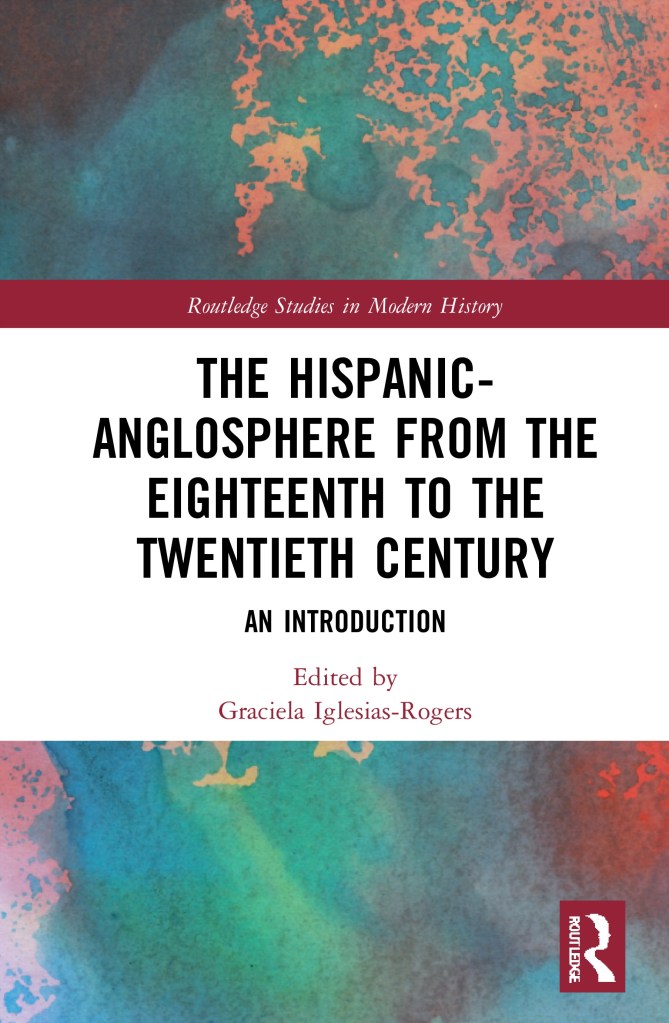
Speakers: Dr Graciela Iglesias-Rogers (University of Winchester) editor and author; Prof. Helen Cowie (University of York), author; and Juan Ignacio Neves Sarriegui (University of Oxford), author.
Discussant: Prof. David Rock (Professor Emeritus University California Santa Barbara).
The event is free and open to the public, and you can attend either in person at the Latin American Centre Main Seminar Room, 1 Church Walk, Oxford OX2 6LY or online, but registration is required (click here). After registering, you will receive a confirmation email containing information about joining the meeting.
And also for your diary:
Date: Wednesday 14th December 16:30-18:00
Location: online – click here for the Teams link
“Spanish America in the political cultures of Spain and the United Kingdom (1824-1850)”.
Speaker: Dr Rodrigo Escribano Roca (Universidad Adolfo Ibañez, Chile)
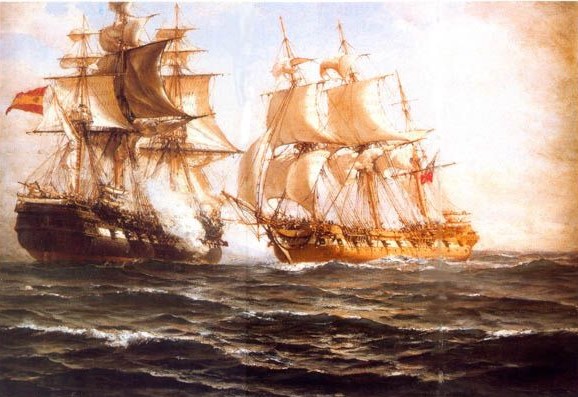
In this talk organized by the Modern History Research Centre (MHRC) of the University of Winchester and the Hispanic-Anglosphere research network, Dr Rodrigo Escribano Roca will introduce his latest book Memorias del viejo imperio. Hispanoamérica en las culturas políticas de España y el Reino Unido (1824-1850) (Madrid: Marcial Pons, 2022) – a study of the impact of Spanish American independence on the political cultures of Spain and the United Kingdom. The disintegration of the Spanish Monarchy in the Americas in the nineteenth century affected two European powers with great intensity. The first was Spain itself, an intercontinental monarchy that transformed into a peninsular state with island possessions. The second was the British Empire that, our speaker argues, had a foreign policy that contributed to emancipate the Hispanic dominions and to incorporate them into its sphere of influence. The book analyses the political thinking in Spain and the United Kingdom during the transitional period following the Atlantic Revolutions (1824-1850). In so doing, it aims to dissect the exercises of mythification of the Spanish Monarchy’s overseas past and the interpretations of the republican developments that took place in Spanish America after the revolutionary schism. The book explains how the ideologized memory of the imperial crisis encouraged Spanish, British and Irish intellectuals to produce knowledge, binding myths, and geopolitical expectations. These myths and expectations were not purely consensual: there was no single Spanish memory or British interpretation of the imperial crisis. Instead, he encountered a kaleidoscope of polemical visions intertwined with a substratum of romanticism, nationalism, and imperialism that responded to the diverse ideological projects of absolutists, moderates, progressives, demo-republicans, socialists, Whigs, Tories, and radicals. The book helps to shed light on the importance of the Spanish-American emancipations in forging the political cultures of both monarchies.
Rodrigo Escribano Roca is Director of the Centre of American Studies at the Universidad Adolfo Ibáñez in Chile. In 2019, he was awarded a doctorate in Philosophy at the School of Humanities and Communications Arts, Western Sydney University, Australia and a similar degree under the banner ‘Latin America and the European Union in the International Context’ by the Instituto Universitario de Investigación en Estudios Latinoamericanos (IELAT), Universidad de Alcalá, Spain. He is Head Researcher of the Chilean Fondecyt (Fondo Nacional de Desarrollo Científico y Tecnológico) Project No. 11200245 “The Pacific Expedition and the Spanish-South American War in the geopolitical imaginaries of liberal Spain (1860-1866)”. He has also published various articles in prestigious journals, such as the Journal of Spanish Cultural Studies, Anuario de Estudios Americanos, Historia Constitucional and Philosophia.
Discussant: Dr James Sanders, Director of Graduate Studies (Utah State University)
Chair: Dr Graciela Iglesias-Rogers, convenor MHRC (University of Winchester)
This event is free and open to the public
For more information, please email MHRC@winchester.ac.uk
Hybrid Event: Hispanic-Anglosphere @ Oxford
You are most welcome to join us in a tertulia in hybrid form (online and in person) organized by the Latin American History Seminar at the University of Oxford to discuss our book The Hispanic-Anglosphere from the Eighteenth to the Twentieth Century – An Introduction (New York and London: Routledge, 2021) on Thursday 17th November, 17:00-18:30 (UK time).
Speakers: Dr Graciela Iglesias-Rogers (University of Winchester) editor and author; Prof. Helen Cowie (University of York), author; and Juan Ignacio Neves Sarriegui (University of Oxford), author.
Discussant: Prof. David Rock (Professor Emeritus University California Santa Barbara).
The event is free and open to the public, and you can attend either in person at the Latin American Centre Main Seminar Room, 1 Church Walk, Oxford OX2 6LY or online, but registration is required (click here). After registering, you will receive a confirmation email containing information about joining the meeting. Notes on speakers and discussants below.
Notes on speakers and discussant:
Graciela Iglesias-Rogers is Senior Lecturer in Modern European and Global Hispanic History at the University of Winchester and lead researcher of the AHRC-funded international research network project ‘The Hispanic Anglosphere: Transnational networks and global communities (18th – 20th centuries)‘ in partnership with The National Trust (Tyntesfield) and the Centre of American Studies at the Universidad Adolfo Ibáñez in Chile. She embarked on academia after life as a Reuters fellow with a long career in journalism, including as Chief European correspondent for the Argentine broadsheet La Nación. At Oxford, she read for a BA degree in History (St. Hilda’s College) followed by a DPhil in Modern History (Lady Margaret Hall). She subsequently held various positions as tutor, lecturer, and researcher (Hertford College, St. Peter’s College, Faculty of History). Her latest publications include ‘The dislocation of the global Hispanic world’, in Alan Forrest and Peter Hicks, eds. The New Cambridge History of the Napoleonic Wars, Volume 3. Experience, Culture and Memory (Cambridge: Cambridge University Press, 2022); (ed.), The Hispanic-Anglosphere from the Eighteenth to the Twentieth Century – An Introduction (New York and London: Routledge, 2021); with D. Hook (eds), Translations in times of disruption: an interdisciplinary study in transnational contexts (Basingstoke: Palgrave, 2017) and British liberators in the age of Napoleon: volunteering under the Spanish flag in the Peninsular War (Bloomsbury: London and New York, 2014).
Juan Neves Sarriegui is DPhil Candidate in History at the University of Oxford. His thesis project ‘Revolution in the Rio de la Plata: Political Culture and Periodical Press, c. 1780-1830’ explores the changes in political life and print culture brought about by the independence movement in present-day Argentina and Uruguay. His has been the ‘Norman Hargreaves-Mawdsley’ scholar at Wolfson College, Oxford (2018-2022) and a DAAD (German Academic Exchange Service) doctoral visiting student at the Institute of Latin American Studies, Free University of Berlin (2022). Currently, he is the Project Manager and Member of the Steering Committee of the AHRC-funded Research Network ‘Reframing the Age of Revolutions, 1750-1850’. He has co-edited a special virtual issue of the Past & Present Journal and published in the collective volume The Hispanic-Anglosphere: an Introduction (2021) edited by Graciela Iglesias-Rogers.
Helen Cowie is Professor of History at the University of York. Her research focuses on the history of animals and the history of natural history. She is author or Conquering Nature in Spain and its Empire, 1750-1850 (2011), Exhibiting Animals in Nineteenth-Century Britain: Empathy, Education, Entertainment (2014) and Llama (2017). Her most recent book, Victims of Fashion: Animal Commodities in Victorian Britain, was published by Cambridge University Press in 2021 and examines 6 luxury animal commodities consumed in the Victorian period. Her work on alpaca wool stems from this wider project.
David Rock is Professor of History Emeritus at the University of California, Santa Barbara and currently Senior Research Associate at the Centre of Latin American Studies, University of Cambridge, where he completed a PhD in 1971. He has written extensively on nineteenth and twentieth century Argentina including several works in Spanish translation. His book Politics in Argentina 1890-1930: the Rise and Fall of Radicalism (Cambridge) was published in 1975. A first edition of Argentina 1516-1982. From Spanish Colonization to the Falklands War (University of California Press) appeared in 1985; Authoritarian Argentine: the Nationalist Movement, its History and its Impact (California) was published in 1992; State Building and Political Movements in Argentina, 1860-1916 (Stanford) was published in 2002; and, The British in Argentina, Commerce, Settlers and Power, 1800-2000 (Palgrave Macmillan) appeared in 2018.
New book: presentation in Viña del Mar, Chile
If you have the good luck of finding yourself in Viña del Mar, Chile during the coming week, you are most welcome to attend the launch of the latest book penned by our colleague Rodrigo Escribano, director of one of our partner institutions, the Centro de Estudios Americanos of the Universidad Adolfo Ibañez. All details in the poster below:

New Working Paper: ‘Pandemics, State-Building, and British-Argentine Connections in the 19th Century’
We are delighted to announce the launch of our Working Paper Series with a thought-provoking piece by our colleague Juan I. Neves-Sarriegui available in open access (pdf) here: ‘Pandemics, State-Building, and British-Argentine Connections in the 19th Century’, Working Paper Series, The Hispanic-Anglosphere: transnational networks, global communities (late 18th to early 20th centuries), WP 22-01, September 2022.
The articles in the Working Paper Series on the Hispanic-Anglosphere constitute “work in progress”. They can be papers prepared for conferences, seminars or simply drafts for any other academic output. They are published to stimulate discussion and to contribute to the advancement of our knowledge of the Hispanic-Anglosphere. All texts are peer-reviewed as it is the norm for all the academic material in our website. The aim of the series is also to accelerate the public availability of the research undertaken by our international research network. An electronic version of the Working Paper Series is available at https://hispanic-anglosphere.com/open-investigations/working-papers/
We have another Working Paper in the pipeline and a wider call for papers will be made shortly – so keep tuned!.
New: Hudson, William Henry (1841-1922)
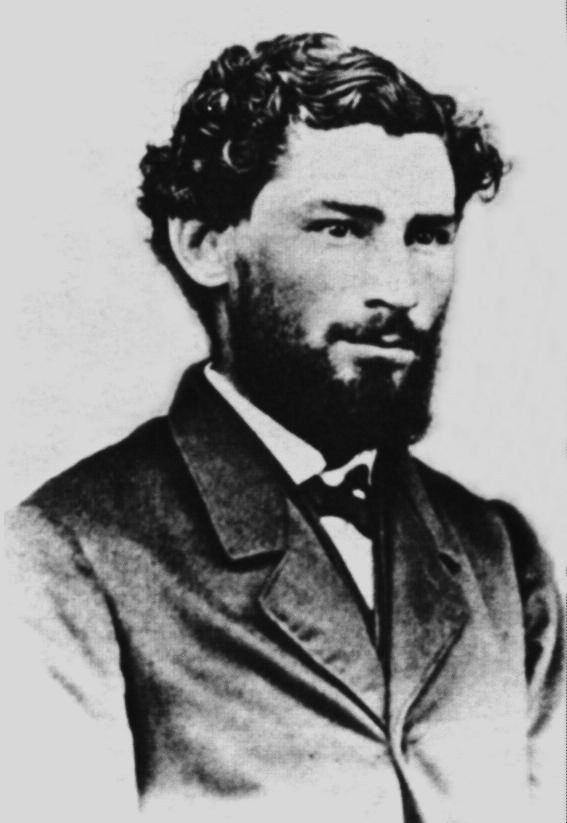


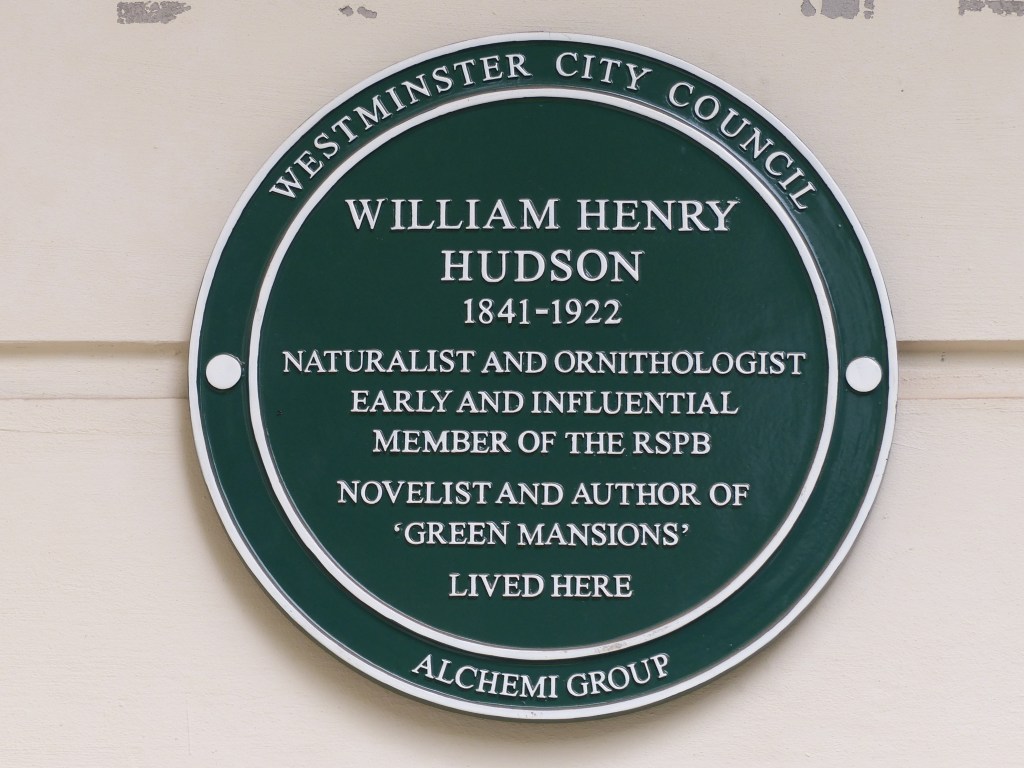
Discover the wildlife activist considered as the world’s first literary environmentalist and key example of the Hispanic-Anglosphere, William Henry Hudson (1841-1922) with the latest biography added to our Individuals section to mark the centenary of his death.
A trailblazer respected and admired equally by scientists (ex. Charles Darwin, Alfred Russell Wallace) and writers (Joseph Conrad, Ezra Pound, Ernest Hemingway) and even by creatives in Hollywood, W. H. Hudson remains a long-term influencer.
Learn all about his fascinating life and contribution to sustainability and natural conservation at https://hispanic-anglosphere.com/individuals/hudson-william-henry-1841-1922/
Two new publications…!
Check out these new publications from members of our Hispanic-Anglosphere research network on the period of the crisis of the Hispanic Monarchy:
- Iglesias-Rogers, Graciela. ‘The dislocation of the global Hispanic world’, in Alan Forrest and Peter Hicks, eds. The New Cambridge History of the Napoleonic Wars, Volume 3. Experience, Culture and Memory (Cambridge: Cambridge University Press, 2022), pp. 550-567. It includes a bibliographical essay in pages 641-2.
Abstract:
Seeking the origins of independence movements in Latin America always brings historians to the period of the Napoleonic wars. Explanations have tended to present developments in the Old Continent as mere backdrop, a trend seemingly validated by traditional Napoleonic scholarship doggedly focused on Europe. It is only recently that a single transoceanic perspective has begun to be applied to the subject. This chapter draws from original research and recent work by economic and cultural historians who moving away from fragmentary and teleological explanations have offered us a different understanding of the make-up and inner workings of the Hispanic world itself. It reveals several little-known facts and developments, including the rise of a vibrant Hispanic-Anglosphere. The emerging picture results from adopting an entanglement approach, well-suited for this volume’s purpose of tracing the legacy of the Napoleonic wars because it demands wide geographical and temporal outlooks commonly deployed by global historians while borrowing also from transnational methods interested more in connections than on drawing comparisons that often obscure the importance of borderless activities and lesser-known actors.
Keywords: Spanish Monarchy; financial crisis; liberalism; constitution; autonomy; Hispanic-Anglosphere; Americas; Philippines; Equatorial Guinea; entanglement
- Brownrigg-Gleeson, José. ‘Fighting an Empire for the Good of the Empire? Transnational Ireland and the Struggle for Independence in Spanish America.’ Radical History Review 2022, no. 143: 32-49.
Abstract:
This article traces Irish responses to the crisis of the Hispanic monarchy (1808-25) and the struggle for sovereignty in Spanish America, comparing reactions in Ireland to those of the Irish diasporic community in the United States. It argues that although the Irish were overwhelmingly sympathetic to the cause of the insurgents in Spanish America, their support took different forms and meanings. Whereas contemporaries in Ireland saw the benefits of Spanish American independence for the prosperity and security of the British Empire, Irish radical exiles in New York or Philadelphia viewed the struggle as an opportunity to emphasize the validity of revolutionary and republican principles across the New World. In stressing the relevance of the geopolitical context and of transnational interactions to the development of contradicting imperial and anticolonial views, the article moves beyond prevailing narratives of military involvement and highlights the richness of the Irish experience of the Age of Revolutions.
Keywords: Ireland, Irish diaspora, Spanish America, United States, Age of Revolutions
If you cannot get hand of a copy of these publications from your library in the coming weeks, drop us an email with your details to hispanicanglosphere@gmail.com and we shall try to help!
Sharing good news…
We’ve got excellent news to share with you: our international research network has secured the operation of the Hispanic-Anglosphere online platform and its domain for seven years (until 2029!) thanks to substantial funding granted by the University of Winchester through the Higher Education Innovation Funding (HEIF) scheme of Research England.
This award constitutes a mark of confidence in the long-term value of our work, and it provides a strong base on which to continue and expand our activities in many ways. More on the latter soon. So, stay tuned!
Hispanic-Anglosphere@Salamanca
On Thursday (19 May), 12:30 pm Dr Graciela Iglesias-Rogers (University of Winchester) will be giving a talk at the Instituto de Iberoámerica de la Universidad de Salamanca (Calle Fonseca 2, Salamanca) under the title: “Nation and nationalism: the role of the Hispanic-Anglosphere). This activity results from an Erasmus staff exchange agreement between the universities of Winchester and Salamanca. The event will be in person and in Spanish (abstract and other details below). If you are around, come and join us!
El jueves (19 de mayo) a las 12:30 la doctora Graciela Iglesias-Rogers (University of Winchester) dará una charla titulada “Nación y nacionalismo: el papel de la Anglósfera-Hispánica” en el Aula 22 del Instituto de Iberoámerica de la Universidad de Salamanca (Calle Fonseca 2, Salamanca). Esta actividad es presencial y tiene lugar gracias a un acuerdo Erasmus de intercambio de staff entre las universidades de Winchester y Salamanca.

Abstracto:
Los mundos hispánico y anglo se representan a menudo como el Caín y el Abel de la cultura occidental, antagónicos y ajenos entre sí. El concepto de la Hispanic-Anglosphere (Anglósfera hispánica) desafía este punto de vista al alentar el estudio de los individuos, redes y comunidades que hicieron de las Islas Británicas un centro de conversión y un puente crucial para el mundo hispánico global (europeo, americano, africano y asiático) desde finales del siglo XVIII hasta principios del XX, un período marcado por la construcción de nuevos estado-nación y el auge de nacionalismos. Esta presentación tomará una visión transnacional y adoptará los métodos de la “historia entretejida” (entangled history en inglés; histoire croisée en francés) avanzados por Werner y Zimmermann para ofrecer dos ejemplos donde el factor “anglo” es una constante en estos procesos en el contexto euro-americano: la adopción del término “colonia” en el mundo hispánico y el papel jugado por el primer consultor político contratado por varios gobiernos sudamericanos en el período inmediatamente posterior a la guerras de independencia, José Joaquín de Mora (1783-1864).
Más información sobre el encuentro / For more information on the event: maes@usal.es; ramoal@usal.es
At SLAS + English Historical Review
A couple of good news…
Our first book The Hispanic-Anglosphere from the Eighteenth to the Twentieth Century – An Introduction (New York and London: Routledge, 2021), this online platform and our activities in general have received a very positive and encouraging evaluation in the prestigious English Historical Review. Click on this title to visit the page of the journal or here to access a copy of the specific article.
If you are attending the annual conference of the Society of Latin American Studies in Bath (SLAS 2022) either in person or virtually this week, come and join us on Thursday 11am to 12:30 pm in the panel ‘Political mistrust and global pandemics: a historical perspective’ (Room 3.16) with Juan Nieves Sarriegui (University of Oxford), Dr Graciela Iglesias- Rogers (University of Winchester) and Samantha Edwards (University of Cambridge).
More info on the SLAS conference here: https://www.bath.ac.uk/corporate-information/society-for-latin-american-studies-slas-annual-conference-2022-schedule/
Launch of Digital Archive AnglophoneChile.org / 7 April
We are delighted to share this invitation to attend the launch of the Digital Archive AnglophoneChile.org with a talk under the title “¿Cómo acceder a los periódicos ingleses de Valparaíso del siglo XIX y al mundo del que ellos nos hablan?” (How to access nineteenth-century English newspapers from Valparaiso and the world they tell us about?)
Date: Thursday 7 April 12:30 PM (Chile time) 16:30 (UK time)
Join Zoom Meeting:
https://uai-cl.zoom.us/j/96082206667?pwd=cGNJZEZYdDlaUTE2bXNsTFo3T3IwUT09
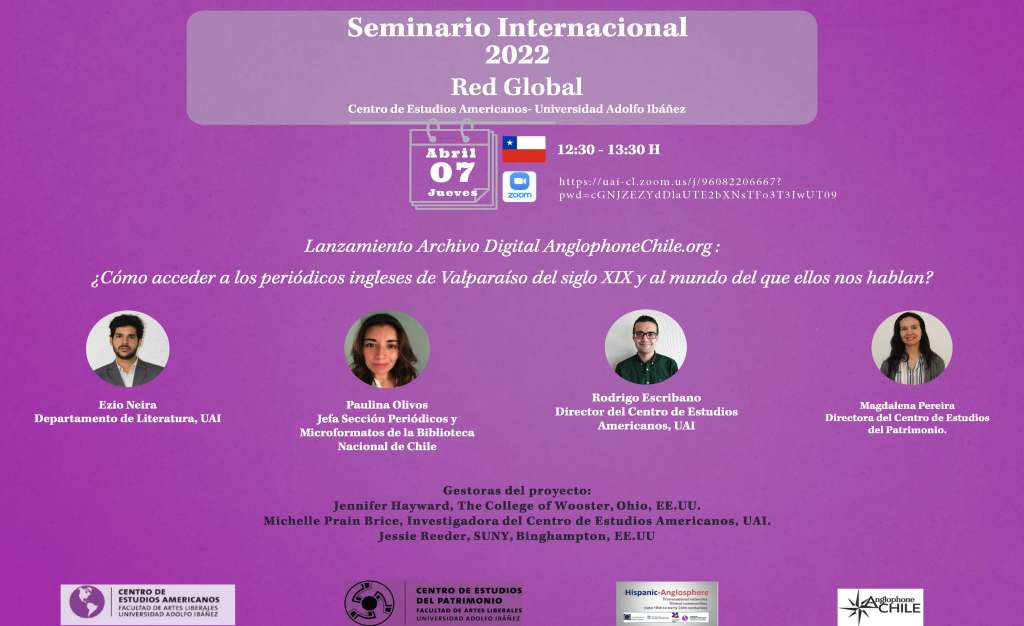
For more information, visit this site: https://www.anglophonechile.org/
Video: The Birth of Primary Schooling in Chile: the role of the Hispanic-Anglosphere
If you missed the talk “The Birth of Primary Schooling in Chile: the role of the Hispanic-Anglosphere” by Dr Andrés Baeza Ruz (Universidad Adolfo Ibañez, Chile) last 2nd March, here is the full video. This event was organized by the Modern History Research Centre of the University of Winchester (UK) and served as the inaugural activity of the Chilean chapter of our international research network at the Centro de Estudios Americanos (Center of American Studies) of the Universidad Adolfo Ibáñez (Chile).
For more information on the Modern History Research Centre and how to access its wide range of expertise, visit their page (click on the image):

 The Hispanic-Anglosphere ...