The Hispanic-Anglosphere …
A research network of scholars and non-academic partners from all around the world who are tracing curious and long-enduring entanglements of the global Hispanic and Anglo worlds, particularly in relation to the British Isles (Cornwall, England, Ireland, Scotland, Wales, the Channel Islands and the Isle of Man)
Online event: “The Irish Diaspora and the ‘Conquest of the Desert’ (1878-1885) in Argentina”
Book your place for this inaugural talk: 22 April 2026 at 16:30 UK time (17:30 Spain; 12:30 Argentina) when Dr Niall Whelehan, head of History at the University of Strathclyde (Scotland) will be giving his inaugural lecture as member of the Hispanic-Anglosphere network with his latest research on Irish migration to Argentina. The event will be online and is being co-organized with the Modern History Research Centre (MHRC) at the University of Winchester. All details here:
Date: Wednesday 22 April 16:30-18:00 (NOTICE: this event was rescheduled from 18 March due to industrial action at the University of Strathclyde)
Location: on Teams – Book your Tickets HERE
The Irish Diaspora and the ‘Conquest of the Desert’ (1878-1885) in Argentina
Speaker: Dr Niall Whelehan (University of Strathclyde)
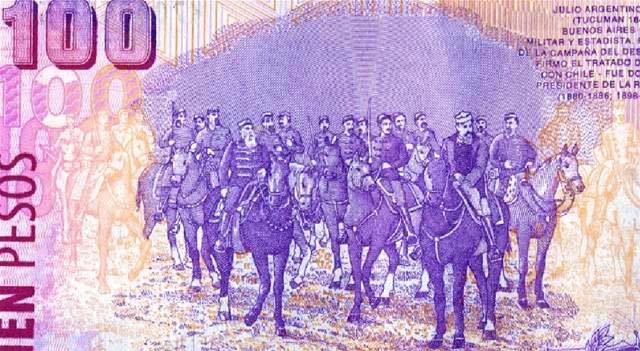
Irish emigration to Argentina never compared in size to the huge numbers that left for North America or Britain, but by the late-nineteenth century a significant Irish Argentine community emerged that contained a powerful elite of business people, ranchers and Catholic clergy. This paper examines first- and second-generation Irish emigrants’ relationships to settler colonialism, in particular both the support and criticism expressed for the so-called ‘Conquest of the Desert’ (1878-1885), the series of violent campaigns conducted by the Argentine military to subjugate indigenous people in the pampas and Patagonia regions. It investigates how some Irish elite figures consciously viewed themselves as agents in global processes of expanding European settlement and the spreading of ideas of ‘civilization’ in the late-nineteenth century, a transformational period in the development of the Argentine nation-state. Irish-owned newspapers in Buenos Aires – The Southern Cross and The Standard – both supported the ‘Conquest of the Desert’, but with notable differences in how they framed their positions. This support coincided with a period of mass political unrest in Ireland and exposed uncomfortable comparisons between the long history of colonial dispossession in Ireland and emigrant participation in settler colonialism in Argentina.
Niall Whelehan is head of History Subject Area and senior lecturer in History at the University of Strathclyde, Glasgow. His publications include Changing Land: Diaspora Activism and the Irish Land War (2021) and The Dynamiters: Irish nationalism and political violence in the wider world,1867-1900 (2012). His present monograph project investigates the Irish diaspora in Argentina during the long nineteenth century.
Chairs: Dr Graciela Iglesias-Rogers (University of Winchester) and Prof. Chris Aldous (University of Winchester)
Everybody is welcome. Book your Tickets HERE
Tickets are FREE for all members of the University of Winchester (register with your university email address), MHRC subscribers (information on the many benefits of subscribing for just £25 a year HERE) and members of the Hispanic-Anglosphere network
Otherwise, Individual entry cost £6 and £3 for concession.
“Re-thinking 200 years of Anglo-Argentine relations” – Full programme
We’re delighted to share with you the full programme of this 5-day online conference to take place from Monday 8th to Friday 12th September. Details on how to book a place are also below.
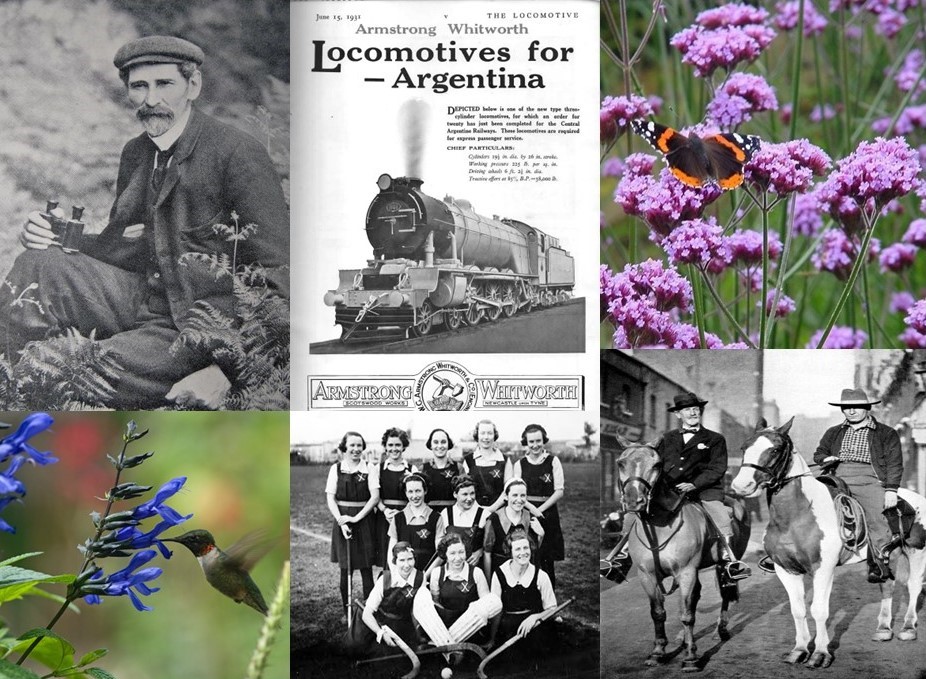
On 2 February 1825, through the signing of a Treaty of Friendship, Commerce and Navigation with the United Provinces of the River Plate (present-day Argentina), the United Kingdom officially recognized for the first time the independence of a Spanish American nation. The community of English, Irish, Scottish and Welsh in Argentina soon became the largest expat community outside the British Empire. This five-day online conference aims to encourage a re-thinking of 200 years of Anglo-Argentine relations by foregrounding new research that acknowledges the existence of a wider Hispanic-Anglosphere to explore a history of common endeavours that may both challenge and bring new light on topics of conflict and sovereignty that have dominated discussions since the Malvinas/Falklands War. Indeed,this will be the first conference in living memory in the UK to look into Anglo-Argentine relations beyond the scope of the South Atlantic conflict. Organized by the Modern History Research Centre at the University of Winchester and the Hispanic-Anglosphere project, the conference looks to foster reflection on topics capable of informing policies on pressing present-day issues such as international trade, freedom of expression, migration and equal access to resources in learning, housing, healthcare, sports and the protection of biodiversity.
Full programme, including abstracts, below with a file available to download.
Everybody is welcome. Book your tickets HERE.
Tickets are FREE for members of the University of Winchester, MHRC subscribers and members of the Hispanic-Anglosphere network. For external attendees, tickets for the 5-day conference cost £25 and £18 for students and pensioners (these prices include a complimentary annual subscription giving access to all hybrid events of the Modern History Research Centre); tickets for a single day/panel cost £12 and £8 for concessions.
Programme
(online – all panels start at 14:00 UK time, 10:00 Argentina, 15:00 Continental Europe)
(Timing of Q&A sessions may vary depending on number/lenght of presentations)
14:00 – 14:15 Opening Remarks: Dr Graciela Iglesias-Rogers (convener, University of Winchester)
14:15–16:45 pm The Hispanic-Anglosphere, empire and the global dimension
- “Spanish preachers in the Anglican Church and St Andrew’s Scots Church in Argentina (1883-1940)”
Paula Seiguer, Professor of Social History (University of Buenos Aires, Argentina), Tenured Researcher (National Council for Scientific and Technical Research –CONICET, Argentina).
- “Subverting Empire: Punjabi migrants in Buenos Aires and London before the First World War“
Benjamin Bryce, Associate Professor (University of British Columbia, Canada)
- “Pedazos antes de nuestra patria”: Revisiting Spanish views of the Anglo-Argentine Treaty of 1825”
José Brownrigg-Gleeson Martínez, Associate Professor (Universidad de Cantabria, Spain)
TUESDAY 9TH SEPTEMBER
14:00–15:45: Nature, urban environment, Sports & the outdoors
Chair: Prof. Eduardo Zimmermann (Universidad de San Andrés, Argentina)
- “Two centuries of Argentine imprint on nature and wildlife activism in Britain”
Graciela Iglesias-Rogers, Senior Lecturer in Modern European and Global Hispanic History (University of Winchester, UK)
- “Diamonds, Arrows, and more’: female hockey and feminism in Argentina 1900-1940”
Patricia Anderson, Lecturer in Latin American History and Culture (Universidad Torcuato Di Tella and Universidad Belgrano)
- “The British community and the construction of the suburban environment in Buenos Aires during the first decades of the 19th Century”
Florencia Rolla, DPhil candidate in Modern History (University of San Andrés, Argentina)
15:45 -16:30: Q&A and general panel discussion
WEDNESDAY 10TH SEPTEMBER
14:00–16:30: International Law, Commerce, the Media
Chair: Prof. Klaus Gallo (Universidad Torcuato Di Tella)
- ‘The Legal Protection of Commerce and the Anglo-Argentine Mixed Claims Commission of 1830’
Lars Janssen, PhD candidate in History (Utrecht University)
- The British-Argentine Press in the 19th Century
Juan I. Neves Sarriegui, Postdoctoral researcher (University of Oxford, UK and La Salle Ramon Llull University, Spain).
- ‘Rogue nation, paradise, then neglect and back again: 200 years of Argentina in the British press’
Graciela Iglesias-Rogers, Senior Lecturer in Modern European and Global Hispanic History (University of Winchester, UK)
16:30 -17:30: Q&A and general panel discussion
THURSDAY 11TH SEPTEMBER
14:00–15:45: Education
Chair: Prof. David Rock (University of California, Santa Barbara)
- ‘San Martín: From Liberator of the Spanish Empire to Symbol of Resistance Against British Imperialism. An Analysis of the Intervention at St. George’s College, Quilmes, Argentina (1950)’
Alina Silveira, Professor of Argentine History (National University of Quilmes, Argentina), Tenured Researcher (National University of Quilmes, Argentina)
- ‘British governesses in Argentina: migrant workers or cultural ambassadors?’
Flavia Fiorucci, Professor of Argentine History (National University of Quilmes, Argentina), Tenured Researcher (National Council for Scientific and Technical Research –CONICET, Argentina).
15:45 -16:30: Q&A and general panel discussion
FRIDAY 12TH SEPTEMBER
14:00–16:00: Health, gender & Sexuality
Chair: Dr Xavier Guégan (University of Winchester)
- ‘Gender and mental alienation within the British community in Buenos Aires’
Stefania Cardonetti, DPhil candidate in Modern History (University of San Andrés, Argentina)
- ‘Travelling the world, selling eroticism, defeating censorship: Armando Bo and Isabel Sarli commercial relationship with Britain (1960-1970)’
Ailin Basilio Fabris, PhD Candidate in Social Sciences and Humanities (Universidad Nacional de Quilmes & Universidad Nacional de La Plata)
16:00-17:30: Closing Forum: Discussions, Reflections, Next Steps (all conference participants)
Full Programme (including abstracts) available in this downloadable file:
—————————————————————–
Rescheduled: “The Irish Diaspora and the ‘Conquest of the Desert’ (1878-1885) in Argentina” – now 22 April
A quick message to let you know that due to industrial action at the University of Strathclyde, this event has been rescheduled for Wednesday 22nd April at the same time (4:30 pm in the UK, 5:30 pm in Spain, but notice that it’ll be 12:30 pm in Argentina). All details of the event HERE.
Blue Plaque hails Scottish diaspora & Argentine WW heroes
A blue plaque with a QR code that links to a webpage with heritage information has been placed at the “Cementerio Parque Bosques de Santa Catalina,” historically known as the Lomas de Zamora Dissidents Cemetery, one of the most important memorial sites for the Scottish community and for Argentines who fell fighting for the Allies during the First and Second World Wars.

The initiative was part of the project “Cartografías Íntimas en Comunidad” (“Intimate Cartographies within the Community”) directed by Dr Mónica Szurmuk and organized by the Universidad de San Martín (UNSAM), CONICET (National Council for Scientific and Technical Research), and funded by the University of Bristol in England, with support from the Heritage Department of the Municipality of Lomas de Zamora.
The history of the cemetery dates back to the 19th century, when the site was part of the Santa Catalina ranch, then part of the Oak Farm estate owned by native of Maine-US banker Wilson Jacobs III. It was acquired in 1884 by the Ferrocarril de la Provincia company to install the Llavallol station on its branch line from La Plata to Cañuelas. In 1890, the branch line passed into the hands of F.C. del Sud, which modified the layout, leaving the site vacant. This encouraged the growing British community in Lomas to campaign for the donation of the land for the creation of a non-Catholic cemetery. The project was commissioned to a local resident, the architect Walter Bassett-Smith and it was inaugurated in 1898. In 1921, after the First World War, the Scottish architect James Smith, resident in Lomas, designed the current chapel/memorial on the site, dedicating it to the Argentine residents who fell in the First World War, and later to those who fell in the Second World War as well.
More information available here: https://cartografiasintimasencomunidad.unsam.edu.ar/cementerio-de-disidentes/
A milestone with a young achiever
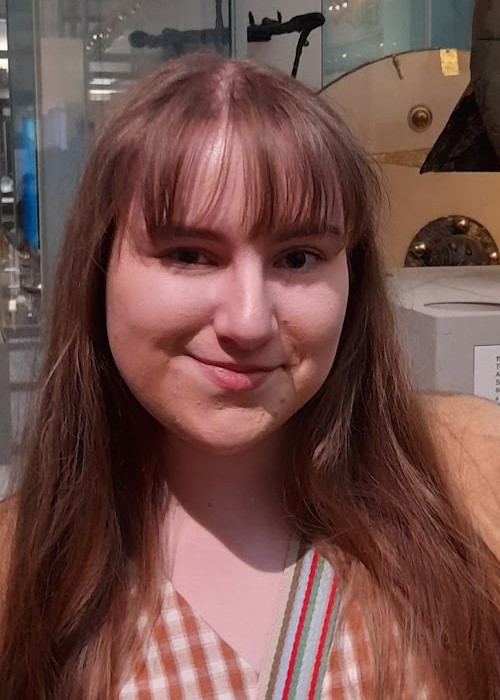
We’ve got 230 people listed in the section of Individuals! Let’s celebrate this milestone and thank Lara Clerck (photo) who has been undertaking the laborious task of producing citeable digital object identifiers (DOIs) for each of the many completed profiles. These DOIs are now feeding the EU Open Research Repository, the AAS Journals, the Biodiversity Literature Repository, among other international research communities, and can be linked with GitHub/ORCID/OpenAIRE accounts.
Lara was selected among dozens of candidates for a 2-month fully-paid apprenticeship to assist in expanding and updating material in the Hispanic-Anglosphere online platform and through the responsible and targeted use of social media.
She is currently transitioning to her last year of History studies at the University of Winchester. Lara undertook a series of volunteering jobs at the British Library and Historic England – and she is doing a splendid job with us. Well done!!
Event: “Echoes Across the Ocean: The Anglophone Press of 19th-Century Chile”, Thursday 15th May, 6 pm
If you’re in London this week, don’t miss this event at the Embassy of Chile in the United Kingdom to celebrate the launch of the digital archive The 19th-Century Anglophone Press of Valparaíso, Chile.
This is a project funded by the British Library’s Endangered Archives Programme in collaboration with the National Library of Chile and the Center for American Studies at Universidad Adolfo Ibáñez.
More information here: https://www.eventbrite.co.uk/e/echoes-across-the-ocean-the-anglophone-press-of-19th-century-chile-tickets-1341958908219?aff=erelexpmlt
Podcast ‘Discovering…at Hampshire’
Check the latest podcast of The Hampshire Archives Trust wholly dedicated to ‘Discovering the Hispanic-Anglosphere’. It’s free and last only 10 minutes or so. Here is the link: https://hampshirearchivestrust.co.uk/stories/podcast/series-3-episode-8-discovering-the-hispanic-anglosphere-in-hampshire
New: Richard Trevithick (1771-1833)
Discover the man who arguably brought the industrial revolution to the Hispanic New World with the first steam engine at silver mines in Peru. The new addition to the biographies in the Individuals section, Richard Trevithick (1771-1833), was authored by Joel Griffett, a Phd student at the Institute of Cornish Studies at the University of Exeter currently researching the activities of Trevithick in Spanish America for this doctoral thesis.
We’re now in Bluesky
You can now follow the Hispanic-Anglosphere News and Events on Bluesky as well !
Search for @hispanic-anglo.bsky.social and give us a follow to be kept up to date with all our latest news, features and events.
Talk in London: 9th October (IHR)
It’s likely that many of you may be interested in attending this talk at the IHR in London on 9 October at 5:30 on ‘The Patriotic Mobilisation of the British Community in Chile during the World Wars: A Transnational Collaboration Network from South America’ by our colleague Roberto Pérez-Castro (Universidad San Sebastián, Santiago de Chile) who recently talked on this subject to our network during the early-career workshop on “New Insights into the Hispanic-Anglosphere”.
It is a hybrid session. More details here: https://www.history.ac.uk/events/patriotic-mobilisation-british-community-chile-during-world-wars-a-transnational
Video – ‘New Insights into the Hispanic-Anglosphere’ (3 September event)
If you missed the workshop ‘New Insights into the Hispanic-Anglosphere’ organized by the Universidad Adolfo Ibañez in Chile (3 September 2024), here is the video. Please notice that it has not been edited so you may need to move the cursor forward to avoid unnecessary introductions and silences.
 The Hispanic-Anglosphere ...